Lightweight Strength Where It Matters
Lightweight Strength Where It Matters
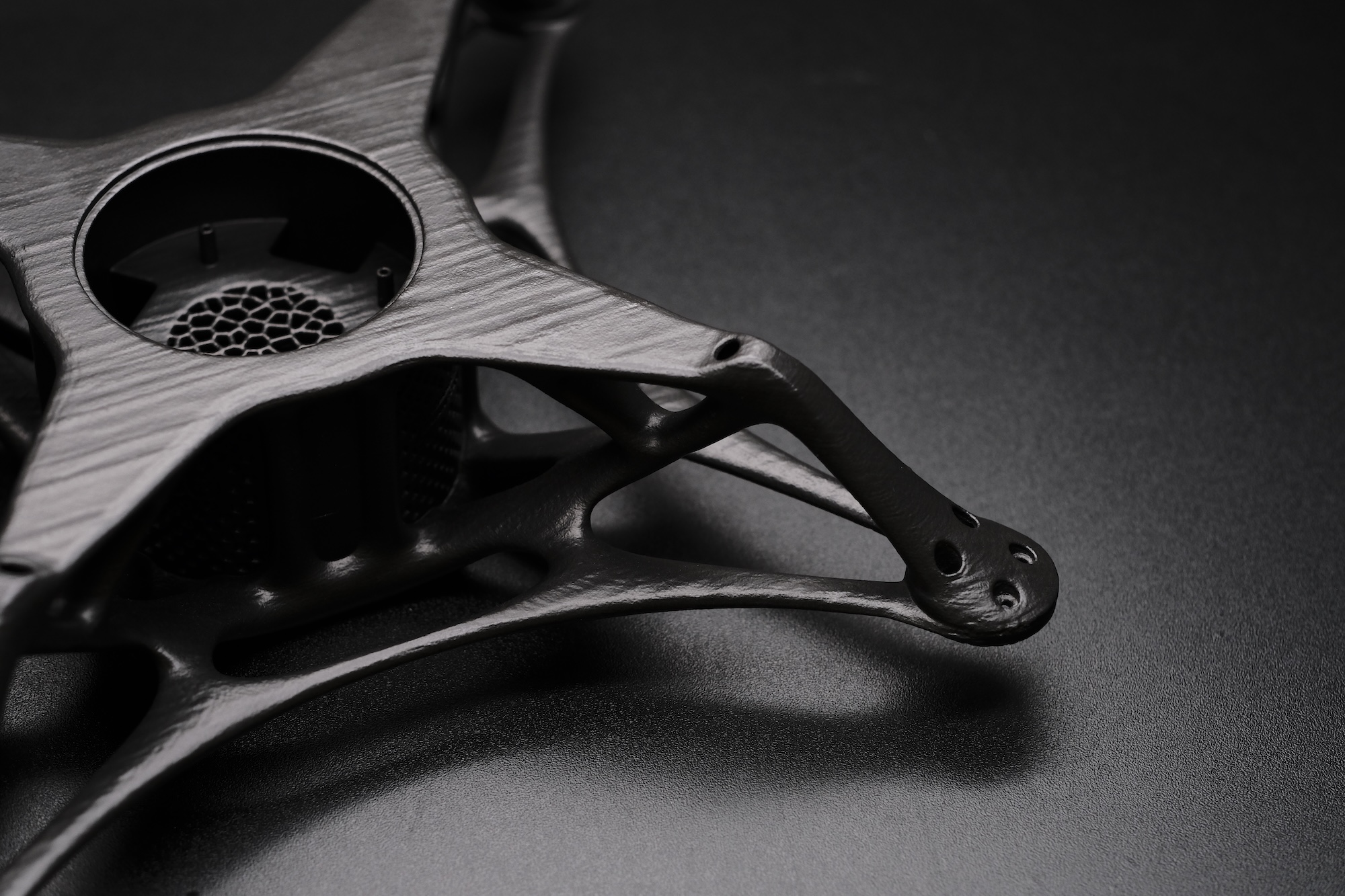
Unmanned aerial vehicles (UAVs) and drones place unique demands on materials. Every gram matters, structures must remain stiff under dynamic loads, and parts are often exposed to vibration, heat, and outdoor environments.
How and Why ALM PA 802 and ALM PA 640GSL Are Helping 3D Print the Next Generation of Drones and UAVs
As drone platforms evolve from prototypes to production systems, additive manufacturing (AM) materials must evolve with them. And evolve they have:
ALM PA 802 and ALM PA 640GSL have emerged as two of the most effective polymer laser sintering materials for addressing these challenges and are enabling lightweight design, structural performance, and repeatable production for UAV and drone applications.
Designers in drone and UAV development are challenged to constantly balance competing requirements:
-
Low weight to maximize flight time and payload
-
High stiffness to maintain dimensional accuracy and flight stability
-
Durability under vibration and cyclic loading
-
Surface quality and feature resolution for aerodynamic efficiency
-
Scalability from development to production
Polymer powder bed fusion 3D printing (also referred to as Selective Laser Sintering or SLS) has become a key manufacturing technology for UAV components, but material selection remains the defining factor in performance and reliability.
ALM PA 640GSL, is lightweight by design. It is a glass sphere and carbon fiber-filled polyamide 12 material engineered specifically for lightweight, dimensionally stable components. For drones and UAVs, this is ideal for:
-
Motor mounts and reinforcement components
-
Aerodynamic test models and wind tunnel parts
-
Performance-critical housings where rigidity is essential
Also, for UAV manufacturers looking to align lightweight performance with sustainability initiatives, PA 802 CN provides a compelling materials solution.
UAV manufacturers have begun pairing PA 640GSL and PA 802 with their designs. Rather than selecting a single material for all components, many drone and UAV programs deploy both materials strategically, PA 640GSL for ultralightweight, aerodynamically sensitive parts, and PA 802 for structural, stiffness-critical components. This combination allows engineers to optimize each part for its functional role, maximizing performance without unnecessary mass.
EOS Polymer System Compatibility
One of the most relied upon and widely available SLS platforms are from EOS. Both ALM PA 640GSL and ALM PA 802 variants are developed and validated for use on EOS polymer laser sintering systems, enabling reliable processing and repeatable results.
-
EOS P 770 – Fully established processing platform for ALM PA 802-CF, while specific use cases have been referenced for ALM PA 640-GSL, with process availability depending on configuration and parameter set
-
EOS P 396 – Fully established processing platform for ALM PA 640-GSL and offering referenced parameters for specific use cases for ALM PA 802-CF
-
FORMIGA P 110 – Preliminary or application-specific use cases have been referenced for ALM PA 802-CF and ALM PA 640GSL
ALM materials are developed with EOS platforms as the primary reference systems, ensuring predictable behavior, strong part quality, and smooth transition from development to production.
As UAV programs scale, consistency and supply reliability become just as important as mechanical performance. ALM’s focus on applicationspecific material development, combined with EOS system compatibility, supports a clear path from early design validation to serial production.
Built for Flight Performance
Drones and UAVs demand materials that work as hard as the engineers who design them. ALM PA 640GSL and ALM PA 802 deliver a powerful combination of lightweight performance, stiffness, surface quality, and production readiness, making them proven choices for next-generation aerial systems.
Whether the goal is extended flight time, increased payload capacity, or improved structural reliability, these ALM materials provide drone and UAV manufacturers with the tools to push performance further.
Would you like more content on 3D printing for drones and UAVs? Click here!
Are you a bit further along in your exploration of 3D printing drones? Now you can also connect with the experts who can help by printing your design: Click here and complete the Drone Benchmark Request. It’s easy: upload your part, then engineers will optimize, print, and review your drone/UAV parts, including design and material recommendations, as well as cost estimations.